Competition—Is It a Race With Technology or a Race With Ourselves?
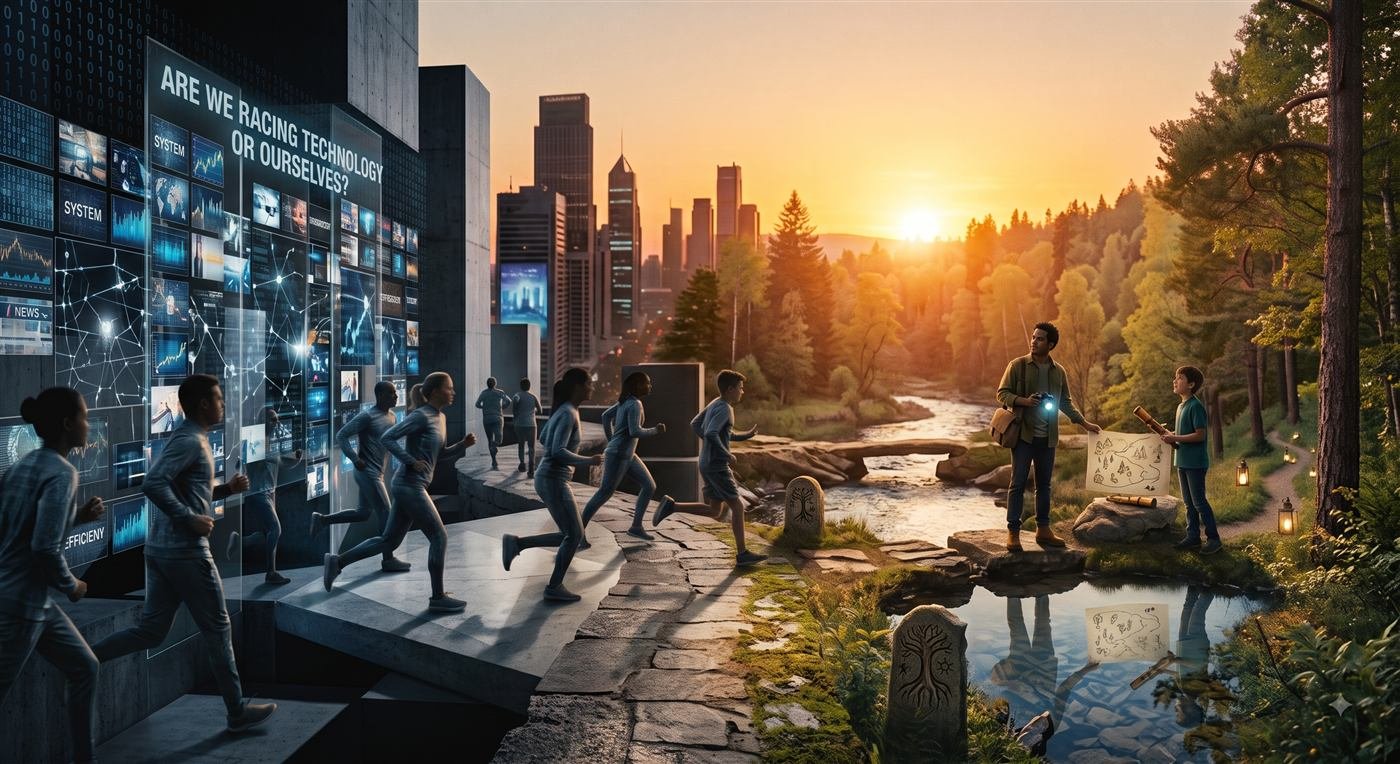
We live in a highly competitive world.
From an early age, we are taught to learn subjects, memorize theories, pass examinations, achieve higher scores, build careers, and compete with others.
But something has changed.
Many of the things we are spending years learning—memorizing information, calculating, processing data, generating content, solving certain kinds of problems—are now being performed by technology faster and, in some cases, better than humans.
So I wonder:
What exactly are we competing for?
If we continue to see everything as a race, perhaps the more important question is:
Who are we actually racing against?
Maybe the first step is to step outside the race for a moment and become an observer.
When we do that, another question appears:
Is this race still relevant, or are we continuing to run simply because previous generations told us that this is how success works?
For many people, this uncertainty is becoming very real.
What should I do with my life?
Why are we competing?
What are we trying to reach?
And most importantly:
Are we using technology as a tool for human progress, or are we gradually shaping human life around the needs of technology?
Technology was created to serve us.
But if we start designing our education, careers, lifestyles, and identities only around what technology can measure or replace, then perhaps we need to pause and rethink the direction.
The Competition May Be Outdated
Competition itself is not necessarily bad.
It can encourage learning, innovation, discipline, and improvement.
But competition becomes harmful when we forget its purpose.
If education becomes only about marks…
If learning becomes only about memorization…
If careers become only about salary…
If success becomes only about comparison…
Then we may produce people who are highly trained to compete but have never had the opportunity to understand what they actually want to contribute.
Technology makes this question even more important.
If a machine can memorize more information than us, perhaps our goal should not be to memorize more than the machine.
If a machine can calculate faster than us, perhaps our purpose should not be to compete with its calculation speed.
If technology can automate repetitive tasks, perhaps we should spend more time developing the qualities that make us uniquely human:
curiosity, empathy, judgment, creativity, relationships, responsibility, adaptability, imagination, and the ability to understand meaning.
Perhaps the future of education is not about competing with technology.
Perhaps it is about learning how to work with technology without losing ourselves in the process.
What About the Child Who Is Growing Up in This Race?
If adults are confused about the future, imagine how confusing this world can be for a student.
We tell children:
“Study hard.”
“Get good marks.”
“Choose the right career.”
“Get a good job.”
“Be successful.”
But perhaps we don’t spend enough time asking them:
What are you curious about?
What kind of problems do you want to solve?
What experiences do you want to have?
What makes you feel alive?
What kind of person do you want to become?
These questions may not produce immediate measurable results.
But they may help a person discover something more important than a career: their own direction.
I Am Not an Expert. I Am an Observer and a Learner.
I don’t claim to have the answers.
I have experienced my own confusion about what to learn, what to pursue, what success means, and where I fit in this rapidly changing world.
But I have also been fortunate.
I have received guidance from teachers, mentors, well-wishers, and people who gave me opportunities to experience life differently.
Those experiences helped me understand that sometimes we don’t need someone to give us the answer.
We need someone who gives us the opportunity to experience, question, fail, learn, and discover the answer ourselves.
That is the kind of contribution I would like to make.
Not by telling the next generation which race they should run.
But by helping create an environment where they can step outside the race and ask:
Is this really the race I want to run?
Maybe Life Isn’t a Rat Race
Perhaps life was never supposed to be a race where everyone follows the same path toward the same definition of success.
Maybe growth is individual.
One person’s success may be building a company.
Another person’s success may be teaching children.
Someone else’s may be caring for their family.
Another person’s may be creating art, researching something unknown, protecting nature, solving a community problem, or simply becoming a better human being.
These paths cannot always be measured using the same scale.
We don’t all have to win the same race.
Maybe the goal is not to outrun everyone else.
Maybe the goal is to understand ourselves well enough to know where we want to go and why.
Technology will continue to evolve.
Jobs will change.
Industries will disappear and new ones will emerge.
The skills we consider valuable today may not be the same skills valued tomorrow.
But if we teach people only how to compete, every technological change may create another crisis of identity.
If instead we teach people how to learn, adapt, question, experience, collaborate, and understand their own calling, change can become an opportunity for growth.
So perhaps the question of our time is not:
“How can I compete with technology?”
Nor even:
“How can I beat everyone else?”
Perhaps it is:
“How can technology help me become more human, while I continue becoming a better version of myself?”
Maybe that is the race worth running.
Not a race against technology.
Not a race against other people.
But a lifelong journey of understanding ourselves, discovering our unique contribution, and creating a positive impact for those who come after us.